Friday, September 25, 2009

Abril Amezcua


This gargoyle, I'm much attention for the position he was, it seems that it has horns and wings, it is a structure that contradicts much. I love it because you always have the feeling they are guarding the city, but with a gloomy air.

One thing I like is that this cathedral appears in "The Hunchback of North dram”. The protagonist lives in the belfry. Her guardian, the judge Frolo, He never lets down the Belfry. In the company of three cute stone gargoyles Victor, Hugo and Laverne, Quasimodo spends hours watching the comings and goings of people. One day, decides to sneak off and meet the beautiful Esmeralda, with her biggest adventure to live. Illusion, friendship and fantasy come together in this great classic Disney.

Omar Hernández


http://www.teslasociety.com/pictures/Roman%20Empire%20Images/RomanEmpire2.jpg
http://www.geocities.com/istanbulplus/foto-AyaSofya3.jpg.jpg

This is the Santa Sofia’s Church or with the name that everybody knows “Hagia Sophia”. This huge cathedral is in Istanbul, Turkey. One of the biggest and most amazing church in Europe.
The cathedral is part of the byzantine art, because it’s ubicated in Constantinople, the byzantine art origin. But this cathedral was Christian until the Byzantine Empire was conquest.
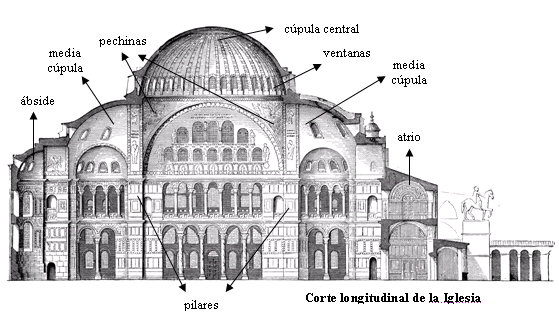
It was built on 532 to 537 by Justino I. This building is based on four arcs and for columns for them, two domes that supported a big dome on the top of the building, in the images we can watch the real size of this dome.
Years later from conquer of the ottomans change the church and convert it into a mosque, and in 1935 was converted into a museum.
If we talk about the structure, it has a base of 77x 71 meters and the big dome is supported by columns and other small domes, the Turks help to put more support on the original church.

http://es.wikipedia.org/wiki/Iglesia_de_Santa_Sof%C3%ADa


Kike!


Well, surfing in my Art and Culture Blog, I saw the two pictures and I thought about which one select for doing my work, then I select the first one, because I thought that choosing this one I was going to improve my knowledge about some cathedral. The reason was that I already know about the Notre dame cathedral and I wanted to discover the world that followed that picture in which I was interested very much.
Now, when I was checking up some links that I found in “GOOGLE” I took some specific information about the history of this mosque, nowadays a museum in Istanbul, Turkey.
The Church of the Holy Wisdom, known as Hagia Sophia in Greek, is a former Byzantine church and former Ottoman mosque in Istanbul. Hagia Sophia is universally acknowledged as one of the great buildings of the world.
Constantine was the first Christian emperor and the founder of the city of Constantinople, which he called "the New Rome." The Hagia Sophia was one of several great churches he built in important cities throughout his empire.
It is one of the greatest surviving examples of Byzantine architecture, rich with mosaics and marble pillars and coverings.
The Hagia Sophia has a classical basilica plan. The main ground plan of the building is a rectangle, 230 feet in width and 246 feet in length. The area is covered by a central dome with a diameter of 102 feet , which is just slightly smaller than that of the Pantheon in Rome.
For over 900 years the Hagia Sophia was the seat of the Orthodox Patriarch of Constantinople and a principal setting for church councils and imperial ceremonies.
http://www.sacred-destinations.com/turkey/istanbul-hagia-sophia
Then viewing, all the pieces of art that make part of this magnificent mosque, I choose some mosaics, but the I chose only one and I think that the Deësis Mosaic was the most important of all the mosaics.
The most famous of Hagia Sophia's Byzantine mosaics is this 13th-century Deësis Mosaic, depicting Christ Pantrocrator flanked by the Virgin Mary and St. John the Baptist.
Christ holds a closed Book of Gospels in his left hand and raises his right in benediction. His gentle expression is that of the "Palaeologan Christ," who reveals God’s compassion for humanity. On either side, the Virgin and St. John the Baptist are turned towards Christ in attitude of worship.
The wistful and grave expressions of Christ and the saints in this mosaic reflect a profound spirituality and announce a new epoch of Byzantine art marked by high aesthetic standards and classical trends.
http://www.sacred-destinations.com/turkey/istanbul-hagia-sophia-photos/slides/deesis-mosaic3-c-hlp
We can have a virtual tour on this beautiful building at: http://www.sacred-destinations.com/turkey/istanbul-hagia-sophia-photos/slides/deesis-mosaic3-c-hlp
In this picture, we can see that the mosaic is a little bit destroyed, cause of the years, but it represents to me the magnifency of Jesus and Santa Maria.
Also, we can see the type of architecture that the Byzantines used to paint in ther mosaics, only one shaped pictures without perspectives, and the image that they had of Christ is our nowadays picture of Jesus and God.

“My representation”
I think that the Byzantines, spend a lot of time, building this mosque that is one of the most important all over the world, when I first saw it I felt tiny, like If I were an ant, I I was overexposed to the humongous piece of art, that I haven’t seen before. It was great…
Bibliography:
http://www.360tr.com/34_istanbul/ayasofya/english/
http://www.sacred-destinations.com/turkey/istanbul-hagia-sophia-floor-plan.html
http://www.vacance-roumanie.com/vacaciones_a_Rumania/La_religion_ortodoxa.html

Diego Fernando


First, I chose the second picture
The moment I saw it, I thought the movie of Wuasimodo. And I thought the Cathedral Notre Dame.
When I saw carefully, I saw that the architecture is gothic in the medieval age. Medieval is like the middle of all. In the Medieval time was like a war with the muslin and Christian.
The Notre Dame Cathedral is in Paris and it started to construction in 1163 and finished in 1345. The appearance of the interior was radically transformed in the 13 century. And the exterior is appears in the High Gothic. This Cathedral functioned for The Christian Religion and to prey.

I chose the Vitrales or Windows. Each one of the colors is a different vitral(windows). And when you saw it you wonder how long it took to made in. The Windows is in the interior of The Cathedral of Notre Dame. Also each window has a figure relation with the Catholic.
I think that in this time did all very detail. In this time most of the temple did a big windows or with a small windows.
The windows is in the high of the cathedral because when the sunrise passes you can see all the light that reflects like a passed for an angel and this light reflect in the door.
I chose the Windows because I like the colors of the windows and in my opinion is reflect like the purity and the glory.
http://www.telefonica.net/web2/sabas/fotos/europa/paris/paris1023.jpg
http://www.discoverfrance.net/France/Cathedrals/Paris/Notre-Dame.shtml

Eduardo Daniel


Architecture
The design of the Sultan Ahmed Mosque is the culmination of two centuries of both Ottoman mosque and Byzantine church development. It incorporates some Byzantine elements of the neighboring Hagia Sophia with traditional Islamic architecture and is considered to be the last great mosque of the classical period. The architect has ably synthesized the ideas of his master Sinan, aiming for overwhelming size, majesty and splendour, but the interior lacks his creative thinking. During the rule of Ahmed I, Sultan Ahmed mosque was built between 1609 and 1616 CE. Designed by architect Sedefkar Mehmet Aga, the Sultan Ahmed Mosque is considered to be the last example of classical Ottoman architecture.
History
After the Peace of Zsitvatorok and the unfavourable result of the wars with Persia, Sultan Ahmed I decided to build a large mosque in Istanbul to placate Allah. This would be the first imperial mosque in more than fourty years. Whereas his predecessors had paid for their mosques with their war booty, Sultan Ahmed I had to withdraw the funds from the treasury, because he had not won any notable victories. This provoked the anger of the ulema, the Muslim legal scholars.


In my opinion
In the image it is possible to see, the interior part of this mosque, they are architectural impressive examples, where every detail of painting can be seen in the whole wall. The part of the crystals can be observed figures, which call very much the attention. It seemed to me to be interesting to speak about this part in it specifies, since, I am called very much the attention, every form that the things have is inside. It seemed that it has sublevels and I imagine like serious to see the things from there, it would be the only experience. This mosque begins of marble, is a stone that at present is very expensive and difficult to obtain. Imagine all that they were late in constructing this great monument, which is recognized worldwide. In his interior the roof is redressed in enormous blue rollers. This beautiful building of blue alive and green color of the mosaics that decorate the top part and the domes of the mosque, is the only mosque in Istanbul, Turkey, which possesses six minarets, which indicates his high hierarchy in the Moslem world since that of Mecca, in Arabia, is the maxim and has in addition seven minarets.


Alan Vincent Viera


I chose the first image. I started my research by searching the name of this church. I used the hints that Charlie gave us. It was a little bit hard to find, but finally, Wikipedia saved the day. This church is named Hagia Sophia or the Holy Wisdom Church in English, or in Spanish, “La Iglesia de Santa Sofia”.
Here are some pictures of the different perspectives.

It was constructed arounde 360 AC by the Constantine emperor and destroyed by to fires. It was reconstructed 530 Ac by the Justinian emperor. It is decorated with the byzantine techniques. In 1453, the Turks built the 4 pilars called minarets.

The architecture of this church is quite interesting. Some of the basic structures are


Dome- It is a hemispherical roof. It has one central vault and some other half-domes around it.
Pillars- A pillar is a column that is used to hold another structure. Specially, it has 4 central pillars that are supporting the central dome.

Arch- A curved construction used to support the weigh above it.

Ground plan of Greek cross- Is basically the way it was constructed. Making a cross in the floor


My opinion about this church is that is an awesome. It reflects the greatness of Constantinopla. I see it like Arabic influence, I don’t know, like the ones that appeared in the Aladdin movie.
It’s amazing that it was burned twice and then reconstructed. In my opinion, if I could restructure it, I would paint it with some other colors, more brilliant.


Bibliography

http://en.wikipedia.org/wiki/Hagia_Sophia
http://www.business-with-turkey.com/guia-estambul/santasfn.shtml
http://rebueno.files.wordpress.com/2009/02/tumadre.jpg
http://personal.telefonica.terra.es/web/galeriasb/europa/turquia/Istambul-Santa-Sofia2.jpg
http://www.artehistoria.jcyl.es/obrmaestras/jpg/CDS11092.jpg
http://www.monografias.com/trabajos55/iglesia-santa-sofia/Image13780.gif
http://rebueno.wordpress.com/2009/02/26/la-arquitectura-de-la-basilica-de-santa-sofia/


Francisco Alfonso Orozco

Well this architecture is a clearly example of byzantine art. I am going to talk about “The Blue Mosque of Istanbul”, or “La Mezquita Azul”.
This beautiful piece of art was build in 1609-1617 (it take too many years how you can see to construct it), and the one that gave the order to construct it was the Sultan Ahmed I. He made it because he wants to abate his god Ala. The reason was that in that period the empire had a lot of problems in his country with the people and with others countries not exactly like wars.
The architect was Mehmet Paşa, I think that to build this beautiful piece of art you need to be one of the best architects in the country.
What you can see in this building that is characteristics of the byzantine art is:
· The kind of material that it was done of, you can think that is done of a simple stone but is not; the byzantine sculpture was characteristic that the architects use beautiful stones and expensive like ivory and marble.
· That it has domes, which are not easy to construct and are really beautiful when they are completely finish, how you can see you can find too many domes in the Mosque, and also the make semi-domes which are like the half of a complete dome.
· They use to make columns that are like the base of all the buildings that are based on this type of art. They are like the places where the building starts growing, and the finish with enormous beaks.
Now the reason that I choose just the top of the Mosque is because all the domes and columns. I really like the way that the columns and the domes are build, because it´s not so easy that it looks too build and I am talking about this time, because it takes to the new workers a lot of time to build a dome or columns now. And now think about how many time does it took to the workers in that period to made this beautiful piece of art it´s really amazing, isn´t? Well this is why I choose this specific place of the Mosque.
Bibliography:
http://www.monografias.com/trabajos32/arte-bizantino/arte-bizantino.shtml#escult
http://es.wikipedia.org/wiki/Mezquita_Azul#Exterior
http://www.estambul-online.com/mezquita_azul.htm